PADI Wreck Diver
WRECK DIVER
Explore History. Develop New Skills. Discover Wrecks.
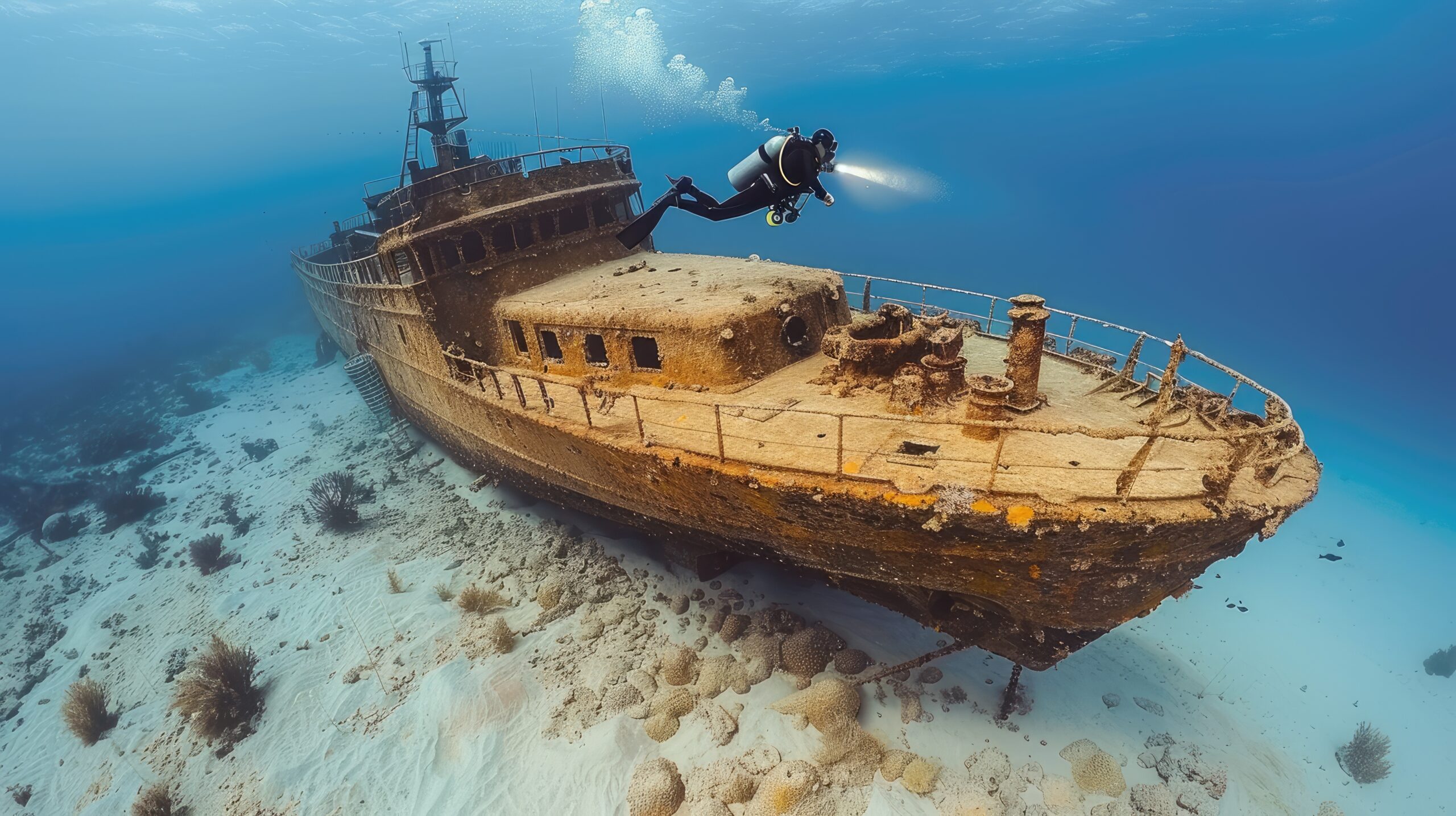
Wrecks offer some of the most fascinating diving in the world. From ships and aircraft to purpose-sunk artificial reefs, every wreck has its own story – and its own challenges.
The PADI Wreck Diver Specialty teaches you how to explore wrecks responsibly while developing the specialist skills needed to plan, navigate and safely conduct wreck dives.
Across up to four open-water dives, you'll learn how to survey and map a wreck, identify potential hazards, use specialised finning techniques and work with lines and reels.
If you've already completed a qualifying Wreck Adventure Dive, such as during your PADI Advanced Open Water Diver course, this may count as your first Wreck Diver training dive – meaning you'll only need to complete three additional dives.
WHAT'S INCLUDED IN YOUR DEEP DIVER COURSE?
PADI Wreck Diver eLearning
3–4 open-water training dives, depending on previous training
Learn how to survey and map a wreck
Identify potential wreck-diving hazards
Develop specialised finning and buoyancy techniques
Learn how to use wreck reels and lines
Develop wreck navigation and exploration skills
Training with an experienced PADI Wreck Specialty Instructor
Full scuba equipment provided
PADI Wreck Diver certification on successful completion
WHAT HAPPENS DURING YOUR COURSE?
Your course begins with PADI Wreck Diver eLearning, where you'll learn about different types of wrecks, wreck-diving equipment, potential hazards and the techniques used to explore them responsibly.
Then you'll put that knowledge into practice.
The complete PADI Wreck Diver Specialty consists of four open-water training dives.
You'll learn how to approach and survey a wreck, identify important features and potential hazards, and develop techniques for navigating around a wreck while maintaining good buoyancy and control.
You'll also practise specialised finning techniques designed to minimise disturbance and learn how to work with lines and reels.
If you've already completed a qualifying PADI Wreck Adventure Dive, this can be credited as Wreck Diver Dive 1 when the relevant requirements are met. In this case, you'll complete the remaining three training dives with us.
As your training progresses, you'll bring these individual skills together to become a more capable and confident wreck diver.
MORE THAN JUST SWIMMING AROUND A WRECK
It's easy to look at a wreck and simply see somewhere exciting to explore.
A trained wreck diver learns to see much more.
You'll learn to consider the wreck's layout, condition, possible hazards, entry and exit points and the surrounding environment before deciding how best to conduct your dive.
Good buoyancy and trim become particularly important around wrecks. You'll develop techniques that help you move efficiently while avoiding unnecessary contact with the wreck or disturbing silt and sediment.
You'll also learn how lines and reels can be used to help maintain orientation and provide a route back towards your starting point.
The aim isn't simply to get closer to wrecks – it's to give you the knowledge, awareness and skills to explore them properly.
Questions You May Have
HOW MANY DIVES WILL I COMPLETE?
The complete PADI Wreck Diver Specialty consists of four open-water training dives.
However, if you've already completed a qualifying PADI Wreck Adventure Dive, such as during your Advanced Open Water Diver course, this may be credited as Wreck Diver Dive 1 when the relevant requirements are met.
In this case, you'll complete the remaining three Wreck Diver training dives with us.
DO I NEED TO BE ADVANCED OPEN WATER CERTIFIED?
Not necessarily.
The prerequisite for PADI Wreck Diver is PADI Adventure Diver or a qualifying certification from another recognised training organisation.
Many divers complete Wreck Diver after Advanced Open Water because it gives them a good foundation of additional diving experience.
WHAT WILL I LEARN?
You'll develop knowledge and practical experience in areas including:
Wreck surveying and mapping
Recognising potential hazards
Wreck navigation
Buoyancy and trim
Specialised finning techniques
Using lines and reels
Planning wreck dives
Wreck-diving equipment and procedures
The aim is to give you the skills to approach wreck diving with greater awareness, control and confidence.
WILL I LEARN TO USE A WRECK REEL?
Yes.
Learning how to work with lines and reels is an important part of the PADI Wreck Diver Specialty.
You'll learn how they're used, how to deploy and follow a line and the considerations involved when using them around a wreck.
WILL WE GO INSIDE A WRECK?
The PADI Wreck Diver Specialty can include limited wreck penetration training when the wreck, conditions and training situation are appropriate.
Any penetration conducted as part of recreational PADI Wreck Diver training remains within very specific limits and requires specialised procedures, equipment and the use of a penetration line.
Not every wreck or course dive will involve penetration.
The decision will always depend on the wreck, conditions, your experience and your instructor's assessment.
WHAT IS WRECK PENETRATION?
Wreck penetration means entering an area of a wreck where direct vertical access to the surface is no longer available.
This introduces additional hazards compared with swimming around the outside of a wreck, including loss of visibility, entanglement, disorientation and restricted access to the surface.
That's why penetration requires additional planning, equipment, line techniques and very careful control.
HOW FAR INSIDE A WRECK CAN I GO?
PADI recreational Wreck Diver training places strict limits on wreck penetration.
Any penetration must remain within the limits of the course and appropriate environmental conditions, with a continuous guideline to the entry point and within the recreational limits established by PADI.
Wreck Diver is not technical wreck or overhead-environment training.
DO I HAVE TO PENETRATE A WRECK TO COMPLETE THE COURSE?
No.
Actual wreck penetration is not required to earn the PADI Wreck Diver certification.
Where penetration isn't appropriate, the relevant line and reel skills can be practised outside the wreck.
WHY IS BUOYANCY SO IMPORTANT AROUND WRECKS?
Good buoyancy and trim are extremely important when wreck diving.
Poor control can cause a diver to make contact with the wreck, damage fragile marine growth or disturb sediment.
Inside or around enclosed sections of a wreck, disturbed silt can also dramatically reduce visibility.
You'll practise techniques that help you move efficiently while minimising disturbance.
WHAT ARE SPECIALISED FINNING TECHNIQUES?
Some normal finning techniques can push water downwards and disturb sediment underneath you.
You'll learn alternative techniques that can help you move around a wreck while reducing the amount of water directed towards the bottom or into areas where sediment could affect visibility.
DOES MY WRECK ADVENTURE DIVE COUNT TOWARDS THIS COURSE?
Yes.
If you've already completed a qualifying Wreck Adventure Dive, such as during PADI Advanced Open Water Diver, it may be credited as Dive 1 of the PADI Wreck Diver Specialty when the relevant requirements are met.
That means you may only need to complete the remaining three Wreck Diver dives.
HOW OLD DO I NEED TO BE?
The minimum age for the PADI Wreck Diver Specialty is 15 years old.
IS ALL THE EQUIPMENT PROVIDED?
Yes. Full scuba equipment is provided for your Wreck Diver training, including the specialist equipment required for the course.
If you already have your own equipment, you're welcome to discuss using it during your training.
DO I NEED TO BE A DEEP DIVER?
No.
PADI Deep Diver isn't a prerequisite for Wreck Diver.
However, wrecks can be found at many different depths. You must always remain within the depth limits of your existing certification and experience.
If the wrecks you eventually want to explore lie deeper than your current training allows, the PADI Deep Diver Specialty is a natural addition to your wreck-diving skills.
WHAT CAN I DO AFTER WRECK DIVER?
Once certified, you'll have a much stronger foundation for exploring the huge variety of wrecks found around the UK and throughout the world.
You can continue developing your diving through specialties such as Deep Diver, Enriched Air Diver, Peak Performance Buoyancy and Underwater Navigation.
For divers who eventually want to progress beyond the limits of recreational wreck diving, further technical and overhead-environment training is available once the appropriate prerequisites and experience have been achieved.
WRECK DIVER HIGHLIGHTS
Ready to discover what's waiting below?
Every wreck has a story – and learning how to explore one properly adds a completely new dimension to your diving.
We'll help you develop the skills, awareness and confidence to start discovering wrecks responsibly.