PADI Diver Propulsion Vehicle (DPV) Diver
DIVER PROPULSION VEHICLE (DPV) DIVER
Go Further. See More. Have More Fun.
Want to cover more of a dive site without spending the whole dive kicking? The PADI Diver Propulsion Vehicle (DPV) Diver Specialty introduces you to one of the most exciting ways to explore underwater.
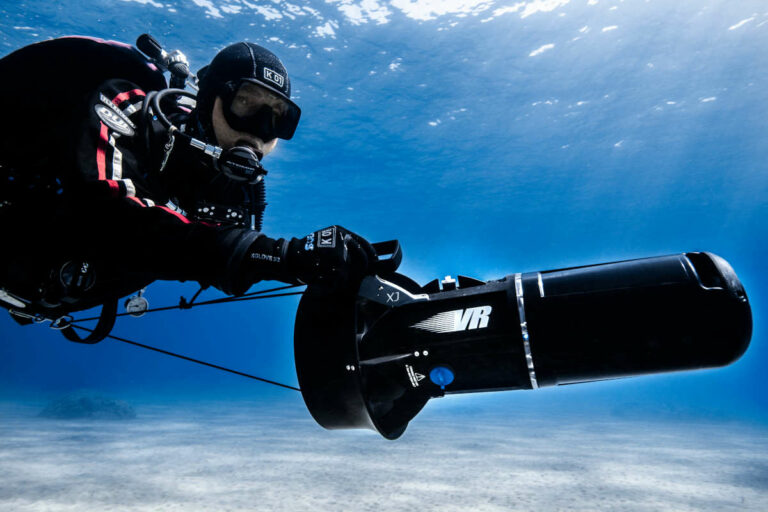
Often called underwater scooters, DPVs pull you effortlessly through the water, allowing you to cover greater distances and experience more of a dive site in a single dive.
Across two open-water dives, you'll learn how to safely operate a DPV, control your speed and direction, make appropriate descents and ascents, stay with your buddy and deal with potential problems.
It's practical, useful – and seriously good fun.
WHAT'S INCLUDED IN YOUR DPV DIVER COURSE?
PADI Diver Propulsion Vehicle Diver eLearning
Two open-water training dives
Learn how to correctly operate and control a DPV
Practise safe DPV descents and ascents
Develop effective turning and manoeuvring techniques
Learn appropriate buddy procedures
Plan dives considering distance, gas and DPV limitations
Learn how to deal with potential DPV problems
Understand DPV care and important equipment considerations
Training with an experienced PADI DPV Specialty Instructor
Full scuba and DPV equipment provided
PADI Diver Propulsion Vehicle Diver certification on successful completion
WHAT HAPPENS DURING YOUR COURSE?
Your course begins with PADI Diver Propulsion Vehicle Diver eLearning, where you'll learn about DPV equipment, dive planning, safe operating procedures and the additional considerations involved when you can travel much further underwater.
Then comes the fun part.
Across two open-water dives, you'll learn how to correctly handle and operate a DPV underwater.
You'll practise starting, stopping, controlling your speed and direction and maintaining a comfortable, streamlined position while using the vehicle.
You'll also learn appropriate techniques for descending and ascending with a DPV, as well as how to stay together and communicate effectively with your buddy.
But DPV diving isn't simply about going faster.
Because a DPV allows you to travel significantly further than you could by swimming alone, good dive planning and gas management become particularly important.
You'll learn how to plan your dive so that you don't travel further than you can safely return if you or your buddy experiences a problem with the DPV.
By the end of the course, you'll have the skills and understanding to use a DPV confidently while keeping the focus where it should be – on safe diving and having a fantastic time underwater.
WHY DIVE WITH A DPV?
A DPV can completely change the way you explore a dive site.
Instead of spending much of your dive swimming between points of interest, you can cover significantly greater distances while using less physical effort.
That can mean exploring more of a wreck, travelling along a reef or covering a larger dive site during a single dive.
They're also simply great fun.
Gliding effortlessly through the water adds a completely different dimension to scuba diving and gives you an incredible feeling of underwater flight.
But travelling further also introduces additional considerations.
If your DPV stops working at the furthest point of the dive, you still need enough gas, time and ability to safely return without it.
That's why proper DPV training is about much more than learning where the trigger is.
Questions You May Have
WHAT IS A DPV?
DPV stands for Diver Propulsion Vehicle.
They're also commonly called underwater scooters.
A DPV uses an electric motor and propeller to pull a diver through the water, reducing the amount of swimming required and allowing you to cover greater distances during a dive.
HOW MANY DIVES WILL I COMPLETE?
The PADI Diver Propulsion Vehicle Diver Specialty consists of two open-water training dives.
During these dives you'll progressively develop your DPV handling, dive-planning and problem-management skills.
WHAT WILL I LEARN?
You'll develop knowledge and practical skills including:
DPV setup and operation
Starting and stopping
Speed and direction control
Turning and manoeuvring
DPV descents and ascents
Buoyancy and streamlining
Buddy procedures
Gas and distance planning
Problem-management procedures
DPV care and maintenance considerations
The aim is to make using a DPV feel controlled, comfortable and natural.
IS A DPV DIFFICULT TO CONTROL?
DPVs are great fun to use, but they do require some technique.
You'll learn how to maintain good body position and buoyancy while controlling the vehicle, as well as how to turn, change direction and adjust your speed appropriately.
Like most diving skills, good DPV control becomes easier with practice.
HOW FAST DOES A DPV GO?
That depends on the particular DPV.
Different models have different speeds, power settings and performance characteristics.
The important part of DPV diving isn't achieving maximum speed – it's learning how to control the vehicle appropriately for the dive, environment and your buddy.
CAN A DPV HELP ME USE LESS AIR?
Potentially.
Because the DPV is doing much of the work that would normally be done by your legs, you may exert yourself less while travelling underwater.
Reduced physical effort can contribute to more efficient gas consumption.
However, gas consumption varies considerably between divers and is affected by factors such as depth, breathing rate, conditions and experience.
A DPV should never be used as a substitute for proper gas planning.
WHY IS GAS PLANNING IMPORTANT WITH A DPV?
Because a DPV can take you much further from your starting point than you might normally swim.
Imagine travelling away from your entry point using a DPV and then having the unit stop working.
You and your buddy may now need to return by swimming.
Your dive plan therefore needs to consider how far you travel, how much gas you have and what you'll do if a DPV becomes unavailable.
Learning to account for this is an important part of your training.
WHAT HAPPENS IF THE DPV STOPS WORKING?
DPV problems are one of the areas covered during your course.
You'll learn appropriate procedures for dealing with a DPV that becomes unavailable and how good dive planning can prevent an equipment problem from becoming an emergency.
Your plan should never rely entirely on the DPV working perfectly for the whole dive.
HOW DO I STAY WITH MY BUDDY?
Buddy awareness becomes particularly important when using DPVs because divers can separate much more quickly than when swimming normally.
You'll learn appropriate buddy positioning, communication and procedures while operating your DPV.
The aim is to enjoy the additional mobility without losing the fundamental buddy practices that apply to recreational diving.
DO I NEED EXCELLENT BUOYANCY?
Good buoyancy makes DPV diving considerably easier and more enjoyable.
You'll need to maintain control of your depth and position while also operating the DPV.
If you'd like to improve your buoyancy and trim before the course, the PADI Peak Performance Buoyancy Specialty is an excellent option.
CAN I USE A DPV AROUND WRECKS?
DPVs can be fantastic for exploring larger wreck sites and covering more distance around the outside of a wreck.
However, using a DPV doesn't change the limits of your existing training.
The PADI DPV Diver Specialty does not qualify you for wreck penetration or other overhead environments.
If wreck diving interests you, consider combining your experience with the PADI Wreck Diver Specialty.
DOES THIS COURSE QUALIFY ME FOR TECHNICAL DPV DIVING?
No.
PADI Diver Propulsion Vehicle Diver is a recreational diving specialty.
Technical, cave and other overhead-environment DPV diving introduces additional risks and procedures and requires appropriate specialist training.
DO I NEED TO BE ADVANCED OPEN WATER CERTIFIED?
No.
You need to be a PADI (Junior) Open Water Diver or hold a qualifying certification from another recognised training organisation.
You don't need to complete Advanced Open Water before taking the DPV Diver Specialty.
HOW OLD DO I NEED TO BE?
The minimum age for the PADI Diver Propulsion Vehicle Diver Specialty is 12 years old.
Junior divers remain subject to the normal PADI age-related depth and supervision requirements.
IS ALL THE EQUIPMENT PROVIDED?
Yes.
Full scuba equipment and the DPV equipment required for your course are provided by Scuba Academy.
You don't need to purchase an underwater scooter before taking the course.
If you already own a suitable DPV, speak to us about using it during your training. Becoming familiar with the particular equipment you intend to dive with can be extremely useful.
CAN A DPV DAMAGE THE UNDERWATER ENVIRONMENT?
Like any diving equipment, a DPV needs to be used responsibly.
Good buoyancy, appropriate speed and awareness of your surroundings are important when operating around marine life, wrecks and sensitive underwater environments.
You'll learn to maintain control and use your DPV in a way that avoids unnecessary contact or disturbance.
WHAT CAN I DO AFTER THE COURSE?
Once certified, you can start incorporating DPVs into suitable recreational dives within the limits of your existing certification, experience and the environment.
DPV diving works particularly well alongside specialties such as Wreck Diver, Deep Diver, Peak Performance Buoyancy and Underwater Navigator.
DPV DIVER HIGHLIGHTS
Ready to put your diving into another gear?
DPVs combine useful diving skills with one of the most enjoyable ways of moving underwater.
We'll teach you how to plan and control your DPV dives properly – then you can concentrate on going further, seeing more and enjoying the ride.